
It seems that the ongoing Coranavirus pandemic has woken Australians up to the important role that local community and country based music can play, in maintaining human mental health and community peace. Dreaming, performing, and paying attention to community music that comes from actual human situations and real life experiences, instead of giving absolute priority to consuming the music of globalised “stars” from distant places and cultures, has a unique power to enliven, build and strengthen human societies and economies. Local song and culture sharing and exchange can, in fact, act as a currency.
The theory that supporting local music cultures and religions inevitably produces jingoistic nationalism, xenophobic hatred and war, does not necessarily apply when healthy intercultural communication is properly promoted by those in authority. Accurate, intelligent, respectful intercultural sharing, that outlaws deliberately offensive behaviour, at local level, has the power to discredit mischief making rumours that incite conflict. Cultures that articulate themselves clearly in music, and explore spiritual and cultural concepts and structures, often communicate with other cultures peacefully, agree to disagree, and find ways to establish reasonable boundaries that maintain peace. In Western Sydney in the early 2000s, Australian Bishop Kevin Manning tested and proved this fact beyond doubt, when he organised a productive series of interfaith conversations between peaceful, intelligent Christians and Muslims, that included music, and quickly restored community peace after an isolated provocateur incident, by sharing common ground, clarifying intercultural issues and discrediting false media myths.
Local Songbooks such as the Dhungala Choral Connection Songbook, produced by Deborah Cheetham, Toni Lalich and Jessica Hitchcock in close collaboration with several Australian Aboriginal communities, are valuable local community building resources for the challenging pandemic era we are living through.
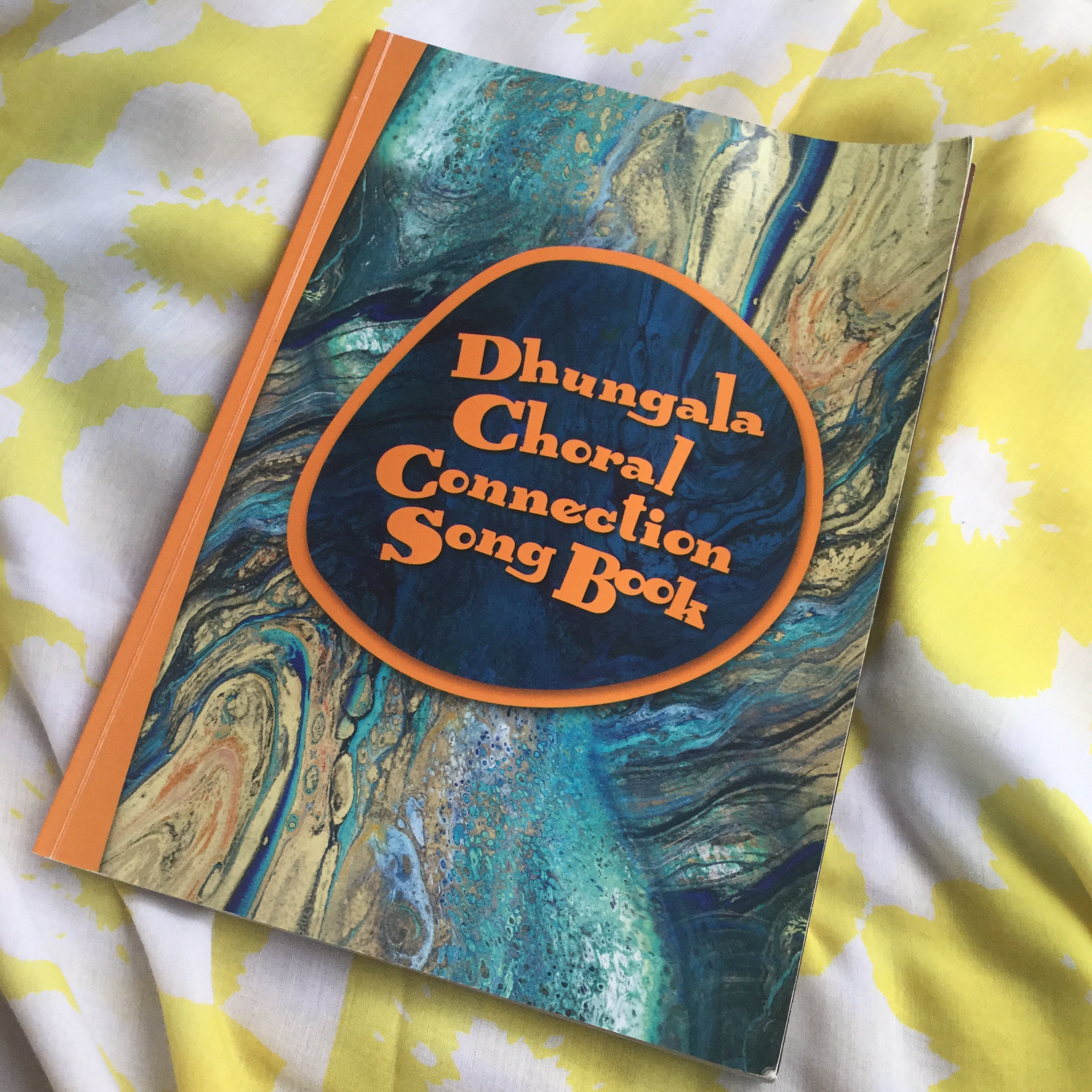
The Dhungala Choral Connection Songbook and an accompanying CD is available at http://www.shortblackopera.com
So, how much health-bestowing local community music is being produced and consumed by Australians, right now? Where is it performed and heard, how is it managed, recorded, licensed and distributed, and who is still making it? When an Australian musician or composer writes, performs and records some of their own music, how do they get it heard by Australian and international audiences? Must they give it away, to be heard? Is wide, government sponsored media distribution provided to our Australian musicians, so their loyal, pandemically challenged fans can access it? And if our local music is being drowned out by insistent promotion of non-Australian music, why is this so?
Have a look online. Many Australian Aboriginal communities are making magnificent, uniquely Australian music. Many non-Indigenous Australian musicians are collaborating with these communities, to grow uniquely Australian community music repertoires with a powerful Australian sound and presence. This is a learning process, and when every Australian gives first priority to supporting uniquely Australian music, instead of incessantly favouring non-Australian performers and non-Australian music genres above our home grown music, our local community music, community cultures, and community peace, will flourish healthily, and grow.
Obviously, we don’t dislike overseas musics, they are wonderful, but why should Australians prioritize non-Australian genres, or promote them above our own musics, to the detriment of the strong multicultural cooperation we have always lived with and built? All Australian citizens have a cultural right and duty to support, grow and enjoy our very own music, that connects us to, and takes pride in, the beautiful country we are privileged to inhabit.
Australian community music appears to be re-emerging from the cultural silencing that the colonial flood, and the post World War II flood, of imported music, induced. We are beginning to realise that denigrating and muting our local musicians’ voices, and obediently patronising, consuming and imitating the avalanche of non-Australian music genres that were, and in many cases still are, permitted to dominate our airwaves, is unlikely to benefit Australia. Australia is no longer stuck in a colonial music time warp, that deems all imported music superior, and all home grown music irredeemably inferior, but we are still vacillating between patronising non-Australian music, and prioritising our local music. Can Australia’s sovereign music needs and rights really be fulfilled with instore muzak such as “In the Bleak Midwinter”, “White Christmas”, or “Jingle Bells”, to cheer us through our smoky heatwave-and-bushfire summers? I don’t think so.
Sadly, the yawning gulf that divorced the truly Australian community music that many older Australians still know and love, from the overwhelmingly foreign music repertoire promoted by Australian media outlets, that is diligently studied and performed in Australian Universities, Conservatoria, and concert halls, has certainly not been bridged. Hands up, if you’ve recently heard identifiably Australian music, performed, recorded and distributed by Australians, in Australia, on an Australian-produced radio or TV program, or a streamed podcast. Hands up, if you’ve listened to, played or sung any uniquely Indigenous Australian song in the last week. If you answered no to these questions, ask yourself why this is so. It is not so in any other country of the world.
Music by non-Australian composers of non-Australian music genres, still floods Australian airwaves, and is still promoted by massive government handouts of public money, that all flow out of Australia, to grow foreign economies. This money should be flowing into local Australian community music systems, to support and grow homespun Australian music. Supporting and protecting local music from external competition is not narrow parochialism or isolationist nationalism, nor is it driven by anti-competitive rhetoric, it’s commonsense social capital building, and giving credit where it’s due.
Many researchers claim that academic studies of “popular music” such as hip hop, rock, soul, electronica and gaming music have broken through the academic / community music divide, by validating the selection and insertion of a carefully selected canon of globalised ‘popular music’ into Australian school and academic curricula. The theory behind this policy, is that establishing a secularised global music repertoire shared by all, will eliminate intercultural and interreligious conflict – John Lennon’s utopian “Imagine” vision of world harmony.
Despite this populist, globalised music education policy, a strict academic / community music divide is still evident in Australian neocolonial systems of music teaching and examination that most Australian music teachers endorse. Grass roots musos are studied by researchers, but how many of these musos read, or are encouraged to respond to, the thousands of academic papers written about them? Popular music syllabuses that include lists of set examination performance pieces, and also teach computer music skills, are shaping future Australian musicians, but only a tiny percentage of the teaching repertoire included in these syllabuses is composed by Australians, or supportive of uniquely Australian music genres and performers.
So what can be done to promote and support the growth of health-giving Australian community music systems and repertoires?
1. Dramatically reduce the excessively high percentage of non-Australian music broadcast on Australian airwaves, in carefully managed stages.
2. Subsidise mainstream radio and TV channels to employ expert Australian Aboriginal music curators and presenters, to monitor and reform depleted Australian music broadcasting quotas, and promote Indigenous broadcasts as restorative justice.
3. Teach Australian children that home grown, truth telling Australian music is of great value to Australia, and is just as good as, and better for Australians, than any music of exclusively non-Australian origin, or music from those who compete with, or actively denigrate, uniquely Australian music cultures and traditions.
4. In our present pandemic situation, generously fund and facilitate the creation and local community performance of uniquely Australian music content, by Australian born and raised composers.
5. Fund an annual Concert Series of Covid Safe live local music events directed and staffed by local Australian musicians, and endorsed by local Australian Aboriginal Elders as fully supportive of our sovereign Australian cultures and ecologies, instead of draining Australia’s music coffers by importing or promoting foreign “big names” who don’t actually need promotion, who often put youth audiences at risk by staging drug-ridden megaconcerts, and then depart, taking our funds with them.


 elizabethsheppardmusic.com
Leave a comment